How to write a sentence. Sounds simple enough, doesn't it? There, I've just written two. In the second, I omitted the subject which should probably be "It"; that is, "It sounds simple . . . ." This "It" standing for "How to write a sentence," the second "it" standing in for "sound simple."
As a native English speaker, I can crank out sentences and analyses like these all day long. Why would I want to read Stanley Fish's thin book, How to Write a Sentence and How to Read One?
Because he will make me—and you—think about sentences, which are, after all, basic to the writer's trade. For example, what is a sentence? Fish points out that writing guides offer answers: "A sentence is a complete thought." "A sentence contains a subject or a predicate." "Sentences consist of one or more clauses that bear certain relationships to one another." He says that "far from being transparent and inclusive, these declarations come wrapped in a fog; they seem to skate on their own surface and simply don't go deep enough."
Okay, professor, what does go deeper? "Well, my bottom
line can be summarized in two statements: (1) a sentence is an organization of
items in the world; and (2) a sentence is a structure of logical relationships." A random list of items, for example, is not a sentence. He quotes Anthony Burgess: "And the words slide into the slots ordained by syntax, and glitter as with atmospheric dust with those impurities which we call meaning." In Fish's formula, "Sentence craft equals sentence comprehension equals sentence appreciation."
He discusses sentence form and how to turn a list of words into a sentence, using the Noam Chomsky example: "furiously sleep ideas green colorless" which can be turned into something meaningful (or more meaningful) as "colorless green ideas sleep furiously," which could be a line of poetry. The question one has to ask oneself when writing a sentence is "What am I trying to do?"
"It is often said," he writes, "that the job of language is to report or reflect or mirror reality, but the power of language is greater and more dangerous than that; it shapes reality, not of course in the literal sense—the world is one thing, words another—but in the sense that the order imposed on a piece of the world by a sentence is only one among innumerable possible orders." And every time you revise a sentence, add a modifier, delete a clause, change a tense you've changed that "reality."
Once Fish has discussed sentences generally, he spends three chapters describing the subordinating style, the additive style, and the satiric style of sentences with examples. Here is a sample of the satiric style. J. L. Austin cautioning readers not to be impatient with the slow unfolding of his argument: "And we must at all costs avoid over-simplification, which one might be tempted to call the occupational disease of philosophers if it were not their occupation."
With practical suggestions of how to form an infinite number of sentences using a relatively few forms, Fish offers chapters on first sentences—"One day Karen DeCilia put a few observations together and realized her husband Frank was sleeping with a real estate woman in Boca" (Elmore Leonard)—and last—"He was soon borne away by the waves and lost in darkness and distance" (Mary Shelley). Wonderful stuff for any writer who is struggling to start a piece or finish one.
The last chapter, "Sentences That Are About Themselves (Aren't They All?)" summarizes and extends the discussion to works like Ford Maddox Ford's The Good Soldier in which the narrator in telling one story is, as the reader comes to realize, unconsciously telling another story entirely.
Every serious writer should keep How to Write a Sentence on the bookshelf to take down every year or so and read once again.
A blog about writing, publishing, reading, translation, Japan, and points between.
Wednesday, September 30, 2015
Tuesday, September 8, 2015
Hannah Ives solves a murder without supernatural help
Marcia Talley has created an interesting character in Hannah Ives. She's a woman of a certain age (as they say), happily married, curious and resourceful. She is not a detective, however, and not a former cop, and I was particularly interested in how Talley, in All Things Undying. was able to create a plausible and satisfying murder mystery with virtually no police involvement. In this ninth Hannah Ives mystery, Hannah and her husband Paul are vacationing for three weeks in Dartmouth, Devon, England. They have good friends locally so they are more than tourists, less than residents.
The action begins when a stranger stops Hannah on the street to give her a message from her long-dead mother. The medium is an American medium Susan Parker, host of a popular UK television show. "Your mother's apologizing. She says she's sorry for not being around when you needed her." Hannah is half-convinced by Susan's recital (and Paul is a thoroughgoing skeptic), and agrees to a private reading the morning after a live performance with audience participation. Before this can take place, however, a hit-and-run driver deliberately runs down and kills Susan. That's Mystery Number One.
Mystery Number Two is what happened locally in 1944. The US Military cleared several square miles of coastline to practice the Normandy landings. Villages were emptied, farmers had to leave their farms. On April 28, 1944, German subs torpedoed two LSTs each carrying more than a thousand men; hundreds of GIs died and not all the bodies washed ashore. An American woman, born shortly after her father had been killed, has come to Dartmouth to find his remains. If Susan Parker can receive messages from the dead, perhaps the dead father will tell her what happened.
So Talley combines an historic tragedy with local culture, the supernatural (or is it) with actual death. And Hannah is in the middle of it all: "There I was, staring through the window of Mullin's Bakery at plain, ordinary everyday pork pasties while getting messages from my dead mother concerning my father's sex life."
Talley does not have to switch to another point of view to convey information to the reader. She is also able to write dialogue that sounds English without funny spellings; for example, " . . . the house is a tip" . . . "you'll need some wellies" . . . "my solicitor think that since it's a cash deal, and there's no chain of sales, we can go to completion on the same day."
All Things Undying is satisfying on several levels. Hannah is able to tell the entire story in her own words. The book skillfully and convincingly weaves together actual history with plausible mystery. The murderer has good reasons for the killing. The issue of whether the dead can communicate somehow with the living is left open. And the scenes of Dartmouth made me want to make a reservation in one of the local B&Bs.
The action begins when a stranger stops Hannah on the street to give her a message from her long-dead mother. The medium is an American medium Susan Parker, host of a popular UK television show. "Your mother's apologizing. She says she's sorry for not being around when you needed her." Hannah is half-convinced by Susan's recital (and Paul is a thoroughgoing skeptic), and agrees to a private reading the morning after a live performance with audience participation. Before this can take place, however, a hit-and-run driver deliberately runs down and kills Susan. That's Mystery Number One.
Mystery Number Two is what happened locally in 1944. The US Military cleared several square miles of coastline to practice the Normandy landings. Villages were emptied, farmers had to leave their farms. On April 28, 1944, German subs torpedoed two LSTs each carrying more than a thousand men; hundreds of GIs died and not all the bodies washed ashore. An American woman, born shortly after her father had been killed, has come to Dartmouth to find his remains. If Susan Parker can receive messages from the dead, perhaps the dead father will tell her what happened.
So Talley combines an historic tragedy with local culture, the supernatural (or is it) with actual death. And Hannah is in the middle of it all: "There I was, staring through the window of Mullin's Bakery at plain, ordinary everyday pork pasties while getting messages from my dead mother concerning my father's sex life."
Talley does not have to switch to another point of view to convey information to the reader. She is also able to write dialogue that sounds English without funny spellings; for example, " . . . the house is a tip" . . . "you'll need some wellies" . . . "my solicitor think that since it's a cash deal, and there's no chain of sales, we can go to completion on the same day."
All Things Undying is satisfying on several levels. Hannah is able to tell the entire story in her own words. The book skillfully and convincingly weaves together actual history with plausible mystery. The murderer has good reasons for the killing. The issue of whether the dead can communicate somehow with the living is left open. And the scenes of Dartmouth made me want to make a reservation in one of the local B&Bs.
Friday, September 4, 2015
How to find reviewers for independently-published books
Do reviews sell books? I'm sure they do not sell as many books as word-of-mouth—a friend's recommendation—but they are more effective than advertising. Book reviews are just one of those things an author has to do to spread the word, and if you are publishing your book independently, few if any media outlets—The New York Times, The New York Review of Books, national magazines etc.—will review your book as a matter of economics and principle. It is, I suspect, just too expensive to try to identify the single jewel in the mountain of self-published pulp that is published every day. So what are we self-published authors to do?
You can pay for a review. A Kirkus Indie reviewer will evaluate your book for $425. You cannot control the review, and if you don't like what it says you can refuse to have it printed in the publication. A former Kirkus reviewer writing in Poets & Writers said that about three quarters of the authors she reviewed elected not to publish.
You can pay a service to contact reviewers for you. Word Slinger Publicity, for example, will "create a book review request, the single most important press release for authors, with our custom HTML template and your book information." Once you approve the release, "we send out your targeted press release to thousands of book reviewers using our own lists and in your genre." All this and more for $150.
Or you can invest time instead of money. Publishers Weekly's booklife now accepts free submissions. However, the website cautions that while "we want to give your book its best chance for a review. . . we can’t review every book that’s submitted." Nevertheless, I believe it's worth the cost of a couple books and postage for the possibility of a review.
Simon Royle maintains an exceptionally useful website, The Indie View, a compilation of 275 reviewers who review independently-published books. These reviewers do not charge for their reviews (or they're thrown off the list), and the listings indicate what exactly the individual reviewers want to see: i.e., "All except non-fiction and erotic fiction;" "non-fiction sports books;" "mostly chick lit-ish and romantic comedy books;" "paranormal romance/urban fantasy," and more and more and more.
As an author, I looked at the websites of all reviewers who seem interested in my genre and followed their instructions for consideration exactly. Start with a query letter that includes a synopsis of the book, a brief bio, and where the book is available. You have to be prepared to send a .mobi file (the Kindle system), or a PDF, or the book itself—it depends on the reviewer. Some want to know your Goodreads address, some are backed up and not currently accepting books, others are backed up but will allow your book to get in line.
Sending a query of course does not guarantee that a reviewer will want to see your book. That a reviewer sees your book of course does not guarantee a review will follow. And of course, you have no control over a reviewer's opinion. (Although, interestingly, many of the reviewers I approached say they will simply not finish a book or post a review if they find it offensive or badly written or edited or all three.)
All this takes time. It is worth it? I have to believe it is or I wouldn't do it. Will it sell books? Who knows? Certainly a positive review cannot hurt.
You can pay for a review. A Kirkus Indie reviewer will evaluate your book for $425. You cannot control the review, and if you don't like what it says you can refuse to have it printed in the publication. A former Kirkus reviewer writing in Poets & Writers said that about three quarters of the authors she reviewed elected not to publish.
You can pay a service to contact reviewers for you. Word Slinger Publicity, for example, will "create a book review request, the single most important press release for authors, with our custom HTML template and your book information." Once you approve the release, "we send out your targeted press release to thousands of book reviewers using our own lists and in your genre." All this and more for $150.
Or you can invest time instead of money. Publishers Weekly's booklife now accepts free submissions. However, the website cautions that while "we want to give your book its best chance for a review. . . we can’t review every book that’s submitted." Nevertheless, I believe it's worth the cost of a couple books and postage for the possibility of a review.
Simon Royle maintains an exceptionally useful website, The Indie View, a compilation of 275 reviewers who review independently-published books. These reviewers do not charge for their reviews (or they're thrown off the list), and the listings indicate what exactly the individual reviewers want to see: i.e., "All except non-fiction and erotic fiction;" "non-fiction sports books;" "mostly chick lit-ish and romantic comedy books;" "paranormal romance/urban fantasy," and more and more and more.
As an author, I looked at the websites of all reviewers who seem interested in my genre and followed their instructions for consideration exactly. Start with a query letter that includes a synopsis of the book, a brief bio, and where the book is available. You have to be prepared to send a .mobi file (the Kindle system), or a PDF, or the book itself—it depends on the reviewer. Some want to know your Goodreads address, some are backed up and not currently accepting books, others are backed up but will allow your book to get in line.
Sending a query of course does not guarantee that a reviewer will want to see your book. That a reviewer sees your book of course does not guarantee a review will follow. And of course, you have no control over a reviewer's opinion. (Although, interestingly, many of the reviewers I approached say they will simply not finish a book or post a review if they find it offensive or badly written or edited or all three.)
All this takes time. It is worth it? I have to believe it is or I wouldn't do it. Will it sell books? Who knows? Certainly a positive review cannot hurt.
Friday, August 28, 2015
Discussion questions: One more tool for your book
Apparently with the growth of book clubs, publishers realized that book discussion questions could be a tool to help readers think and talk about a book. I think that if publishers think book discussion questions are a good idea, I should think about them. And I've not only thought about them, I've had them written for all three of my novels. Indeed, I posted questions for the brand new book yesterday, and if you click on the button above this entry, you can find them.
I had no idea whether the questions for the earlier novels were used or useful. No reader has ever written to say, "Boy, your discussion questions really enriched my experience of your book." But thanks to Blogspot, I can track page views, and I've been interested to see how many page views the discussion questions for Getting Oriented and The Girl in the Photo have accumulated. I would like to think that most of those visitors have read about the book, read the sample chapter, read the questions and bought the book and thereby had the complete experience. I would like to think that, but I know better.
Nevertheless, I believe discussion questions are a valuable adjunct to a book. They are not easy to write. I have not written mine because, I suspect, I am too close to the book. If you can write them, do so. If you cannot, find a careful, thoughtful reader who can. They are one more tool in your box, one more arrow in your quiver, one more . . . But you know what I mean.
I had no idea whether the questions for the earlier novels were used or useful. No reader has ever written to say, "Boy, your discussion questions really enriched my experience of your book." But thanks to Blogspot, I can track page views, and I've been interested to see how many page views the discussion questions for Getting Oriented and The Girl in the Photo have accumulated. I would like to think that most of those visitors have read about the book, read the sample chapter, read the questions and bought the book and thereby had the complete experience. I would like to think that, but I know better.
Nevertheless, I believe discussion questions are a valuable adjunct to a book. They are not easy to write. I have not written mine because, I suspect, I am too close to the book. If you can write them, do so. If you cannot, find a careful, thoughtful reader who can. They are one more tool in your box, one more arrow in your quiver, one more . . . But you know what I mean.
Wednesday, August 26, 2015
My experience with Kindle Scout
As I wrote in an earlier blog post, Kindle Scout is an opportunity for writers to receive a $1,500 advance and have their books electronically published by Kindle Press. I learned of the program just as I was about to independently publish my mystery, Death in a Family Business, and felt I had nothing to lose by participating.
I uploaded my cover, text, my carefully crafted book description, and answers to three questions about the book. (You may still be able to see my entry here, although my campaign ended.) Once you've uploaded your book, you have 30 days to get as many relatives, friends, and strangers to nominate it as possible. I wrote everyone I knew, posted on LinkedIn, on Facebook, and asked for nominations.
The book was not selected. I don't know why. Not enough nominations? A weak cover? First chapters too slow? The Kindle staff's judgement of its potential? An Amazon algorithm that forecasts sales? Who knows?
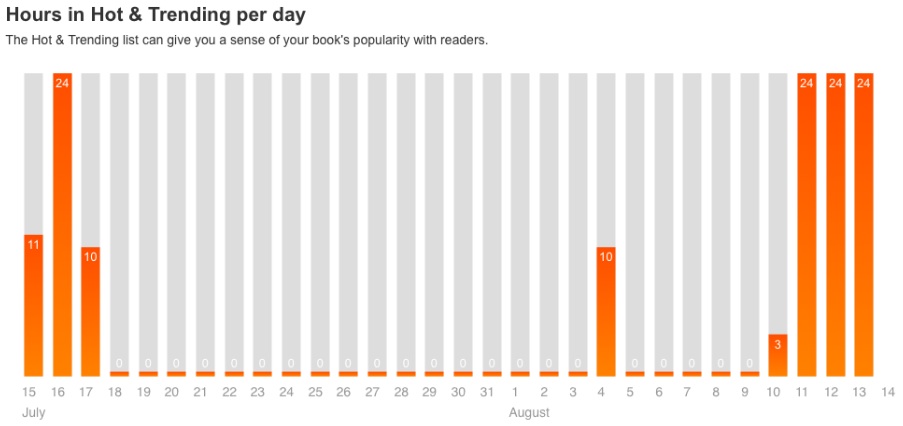
I do know that my book was Hot & Trending 18 percent of the time it was up (130 hours out of 720) because after the campaign Kindle Scout gave me access to the statistics with two attractive charts:
Kindle did not, however, tell me how the statistics relate to their decision whether to publish the book. I do know that 214 page views came from external sources; 356 from Kindle Scout, but how many of those Scout page views turned into nominations? That is, I am sure that my relatives and friends nominated my book, but how many Scouters read the blurb, scanned the first couple chapters, and then took a pass? I have no idea. And would it make any difference in the selection?
Nevertheless, I believe the Kindle Scout program is worth a writer's consideration. It costs nothing to enter. Whether a book is selected or no, what you have to do amounts to a pre-publishing publicity campaign—a good thing. If you are not selected and go ahead and publish on Createspace (another Amazon company) as I have done, Kindle notifies everyone the book is available. If people buy, read, and review my book, that would be even a better thing.
I uploaded my cover, text, my carefully crafted book description, and answers to three questions about the book. (You may still be able to see my entry here, although my campaign ended.) Once you've uploaded your book, you have 30 days to get as many relatives, friends, and strangers to nominate it as possible. I wrote everyone I knew, posted on LinkedIn, on Facebook, and asked for nominations.
The book was not selected. I don't know why. Not enough nominations? A weak cover? First chapters too slow? The Kindle staff's judgement of its potential? An Amazon algorithm that forecasts sales? Who knows?
I do know that my book was Hot & Trending 18 percent of the time it was up (130 hours out of 720) because after the campaign Kindle Scout gave me access to the statistics with two attractive charts:
Kindle did not, however, tell me how the statistics relate to their decision whether to publish the book. I do know that 214 page views came from external sources; 356 from Kindle Scout, but how many of those Scout page views turned into nominations? That is, I am sure that my relatives and friends nominated my book, but how many Scouters read the blurb, scanned the first couple chapters, and then took a pass? I have no idea. And would it make any difference in the selection?
Nevertheless, I believe the Kindle Scout program is worth a writer's consideration. It costs nothing to enter. Whether a book is selected or no, what you have to do amounts to a pre-publishing publicity campaign—a good thing. If you are not selected and go ahead and publish on Createspace (another Amazon company) as I have done, Kindle notifies everyone the book is available. If people buy, read, and review my book, that would be even a better thing.
Monday, August 24, 2015
And now for another point of view . . .
A good friend passed along Us by David Nicholls, saying she thought I would enjoy it. She knows my taste. The book is laugh-out-loud hilarious, interestingly constructed, and ultimately satisfying. I wouldn't go as far as the Independent's blurb on the back cover ("A perfect book"), but I recommend it for the story and for the way Nicholls tells it. I'm not alone. Other readers enjoyed Us. At this writing, the novel has something like 240 five-star reviews on Amazon. Which made me wonder about the opinions of the handful of people who gave it one or two stars. Did they read the same book?
One reader wrote, "I found this book to be long [almost 400 pages] and boring and the main character to be pathetic."
And not only the main character. Another disappointed reader asked, "It is not enough to have a son raised without discipline and as a result no respect for himself or anyone around him? Add to it a wife who has no respect for her husband and constantly teams up with their son to demean him . . . "
A similar opinion: "I found the main characters unrealistic, particularly the husband. Nobody can be passive and agreeable . . . "
One more: "Slow-moving anti-capitalism and anti-child discipline novel written by a disgruntled Brit. Waste of time and money, and highly over-rated by the media." Oh, sure; blame the media.
I like to read Amazon's one- and two-star reviews because (a) you can be pretty sure that in their way they're objective; the author's friends didn't write them, and (b) these people say what they truly think: "Boring writing. Boring protagonist. Couldn't wait to finish this book so that it was over."
As a response to all this negativity, let me give you a few examples of why I thoroughly enjoyed Us. We are at a vegetarian buffet in Amsterdam with the narrator, Douglas; his wife, Connie; his son, Albie; and taken there by Cat, a girl busker with whom the son has connected: "'Isn't it incredible? Who needs meat?' said Cat who, the last time I saw her, had been stuffing her rucksack with bacon like some crazed taxidermist."
In the course of the novel, the Douglas flashes back to memories of his marriage: "Connie was an undeservedly confident driver and owned a battle-scarred old Volvo with moss growing in the window frames and forest floor of crisp packets, cracked cassette cases and old A-to-Zs. She drove with a kind of belligerent sloppiness, changing the music more often than she changed gear, so that tensions were already quite high as we pulled up outside my family home . . ."
And sprinkled throughout are Nicholls' observations that caused me to stop and reflect: ". . . it occurred to me that perhaps grief is as much regret for what we have never had as sorrow for what we have lost." "We think we have independence and imagination, but we have no more freedom to roam than trams on rails." "From an evolutionary point of view, most emotions—fear, desire, anger—serve some practical purpose, but nostalgia is a useless, futile thing because it is a longing for something that it permanently lost . . . "
I am delighted my friend passed Us along to me. I can only recommend it to you.
One reader wrote, "I found this book to be long [almost 400 pages] and boring and the main character to be pathetic."
And not only the main character. Another disappointed reader asked, "It is not enough to have a son raised without discipline and as a result no respect for himself or anyone around him? Add to it a wife who has no respect for her husband and constantly teams up with their son to demean him . . . "
A similar opinion: "I found the main characters unrealistic, particularly the husband. Nobody can be passive and agreeable . . . "
One more: "Slow-moving anti-capitalism and anti-child discipline novel written by a disgruntled Brit. Waste of time and money, and highly over-rated by the media." Oh, sure; blame the media.
I like to read Amazon's one- and two-star reviews because (a) you can be pretty sure that in their way they're objective; the author's friends didn't write them, and (b) these people say what they truly think: "Boring writing. Boring protagonist. Couldn't wait to finish this book so that it was over."
As a response to all this negativity, let me give you a few examples of why I thoroughly enjoyed Us. We are at a vegetarian buffet in Amsterdam with the narrator, Douglas; his wife, Connie; his son, Albie; and taken there by Cat, a girl busker with whom the son has connected: "'Isn't it incredible? Who needs meat?' said Cat who, the last time I saw her, had been stuffing her rucksack with bacon like some crazed taxidermist."
In the course of the novel, the Douglas flashes back to memories of his marriage: "Connie was an undeservedly confident driver and owned a battle-scarred old Volvo with moss growing in the window frames and forest floor of crisp packets, cracked cassette cases and old A-to-Zs. She drove with a kind of belligerent sloppiness, changing the music more often than she changed gear, so that tensions were already quite high as we pulled up outside my family home . . ."
And sprinkled throughout are Nicholls' observations that caused me to stop and reflect: ". . . it occurred to me that perhaps grief is as much regret for what we have never had as sorrow for what we have lost." "We think we have independence and imagination, but we have no more freedom to roam than trams on rails." "From an evolutionary point of view, most emotions—fear, desire, anger—serve some practical purpose, but nostalgia is a useless, futile thing because it is a longing for something that it permanently lost . . . "
I am delighted my friend passed Us along to me. I can only recommend it to you.
Wednesday, August 19, 2015
Kierkegaard and murder, a gratifying combination
Daniel Peters tells his own story in Thom Satterlee's novel, The Stages, which is an interesting story even without the murder of Daniel's boss and former girlfriend—although of course that's the thread that pulls us through the pages.
Daniel is a middle-aged American man who has lived in Copenhagen for twenty years where he works as a translator at the Søren Kierkegaard Research Center. An extremely circumscribed life with minimal human contact and a rigid routine suits Daniel who suffers from Asperger's syndrome.
According to the National Institute of Neurological Disorders and Stroke, "Asperger syndrome is an autism spectrum disorder characterized by social impairment, communication difficulties, and restrictive, repetitive, and stereotyped patterns of behavior. Asperger syndrome is . . . synonymous with the most highly functioning individuals with ASD. Two core features of autism are: a) social and communication deficits and b) fixated interests and repetitive behaviors. The social communication deficits in highly functioning persons with Asperger syndrome include lack of the normal back and forth conversation; lack of typical eye contact, body language, and facial expression; and trouble maintaining relationships." It makes Daniel a brilliant translator but hobbles him as a freelance investigator. He cannot tell when someone lying or speaking ironically.
The Stages opens with the funeral of Matte Rassmussan, the director of the Søren Kierkegaard Research Center. She's been brutally hacked to death; Daniel had seen her the night of her death; the Copenhagen police have no suspects although they certainly have questions for Daniel. Adding to the mystery, recently-discovered Kierkegaard manuscript has gone missing from the vault where it was stored. Fortunately—or not—Daniel had already translated the contents.
As an amateur translator myself, I was interested in Daniel's description of the work: . . . "[I] pay attention to words, hear what they say and say back what they mean, what they could mean or most likely would mean in English rather than Danish; what the words mean, in some sense, beyond both languages, in another more essential language, which is like a sea I cast into and draw out words—some I throw back, others I keeps; and I do this over and over again in my mind, until whole sentences of the right words are strung together with a rhythm that holds them like a taut wire—and these word-strung wires I place carefully on the lines of my exercise booklet, one after another, down the page and onto the next."
Because of the story Satterlee is telling, the reader learns a great deal about Kierkegaard's life and work, including how to pronounce his name ("Kyerk-ah-gore"). Because of the setting, we learn something about Danish life and culture. For example, "If I have to be the suspect in a murder case, let it be Copenhagen where a senior officer brews fresh strong coffee and offers you sugar from a crystal bowl." Because of Satterlee's skill, we never leave Daniel's point of view, and reading what Daniel does, and why and how does it seems entirely plausible and convincing. I'll second Publishers Weekly's blurb: "A deftly crafted mystery that will leave readers curious and surprised." I was surprised and satisfied.
Daniel is a middle-aged American man who has lived in Copenhagen for twenty years where he works as a translator at the Søren Kierkegaard Research Center. An extremely circumscribed life with minimal human contact and a rigid routine suits Daniel who suffers from Asperger's syndrome.
According to the National Institute of Neurological Disorders and Stroke, "Asperger syndrome is an autism spectrum disorder characterized by social impairment, communication difficulties, and restrictive, repetitive, and stereotyped patterns of behavior. Asperger syndrome is . . . synonymous with the most highly functioning individuals with ASD. Two core features of autism are: a) social and communication deficits and b) fixated interests and repetitive behaviors. The social communication deficits in highly functioning persons with Asperger syndrome include lack of the normal back and forth conversation; lack of typical eye contact, body language, and facial expression; and trouble maintaining relationships." It makes Daniel a brilliant translator but hobbles him as a freelance investigator. He cannot tell when someone lying or speaking ironically.
The Stages opens with the funeral of Matte Rassmussan, the director of the Søren Kierkegaard Research Center. She's been brutally hacked to death; Daniel had seen her the night of her death; the Copenhagen police have no suspects although they certainly have questions for Daniel. Adding to the mystery, recently-discovered Kierkegaard manuscript has gone missing from the vault where it was stored. Fortunately—or not—Daniel had already translated the contents.
As an amateur translator myself, I was interested in Daniel's description of the work: . . . "[I] pay attention to words, hear what they say and say back what they mean, what they could mean or most likely would mean in English rather than Danish; what the words mean, in some sense, beyond both languages, in another more essential language, which is like a sea I cast into and draw out words—some I throw back, others I keeps; and I do this over and over again in my mind, until whole sentences of the right words are strung together with a rhythm that holds them like a taut wire—and these word-strung wires I place carefully on the lines of my exercise booklet, one after another, down the page and onto the next."
Because of the story Satterlee is telling, the reader learns a great deal about Kierkegaard's life and work, including how to pronounce his name ("Kyerk-ah-gore"). Because of the setting, we learn something about Danish life and culture. For example, "If I have to be the suspect in a murder case, let it be Copenhagen where a senior officer brews fresh strong coffee and offers you sugar from a crystal bowl." Because of Satterlee's skill, we never leave Daniel's point of view, and reading what Daniel does, and why and how does it seems entirely plausible and convincing. I'll second Publishers Weekly's blurb: "A deftly crafted mystery that will leave readers curious and surprised." I was surprised and satisfied.
Thursday, August 13, 2015
What's wrong with Times New Roman?
In a discussion I follow about self-publishing and book design, a knowledgeable participant wrote: "But whatever you do, DON'T EVER set a book in Times New Roman or a comic font. . . ."
What's wrong with Times New Roman? She cited three reasons: "First, it's a narrow font, designed to make newspaper columns work better. On the wider page of a book, with the longer line length? It makes your eyes get tired faster." Second, "it makes your book look subtly 'wrong' to those who are less clued-in." Third, "MS Word uses it as a default font, and beginners always use it, because they're used to it. It's acceptable for basic word-processing documents, but not for books. Using it labels you as not well-informed, leading those who can do your book a lot of good (or not) to put the book on the 'ignore' pile."
Ouch. My three novels are set in Times New Roman. Not much I can do about the first two, but I could still change Death in a Family Business type, so I experimented. Here are the results:
What's wrong with Times New Roman? She cited three reasons: "First, it's a narrow font, designed to make newspaper columns work better. On the wider page of a book, with the longer line length? It makes your eyes get tired faster." Second, "it makes your book look subtly 'wrong' to those who are less clued-in." Third, "MS Word uses it as a default font, and beginners always use it, because they're used to it. It's acceptable for basic word-processing documents, but not for books. Using it labels you as not well-informed, leading those who can do your book a lot of good (or not) to put the book on the 'ignore' pile."
Ouch. My three novels are set in Times New Roman. Not much I can do about the first two, but I could still change Death in a Family Business type, so I experimented. Here are the results:
While the Goudy and Baskerville faces are somewhat more open than Times New Roman, they do not seem different enough to make the effort to change the entire book.
Bookman, however, is both more open and more readable and if I were starting from scratch I would use it. Unfortunately because it is more open it adds space, and I calculated that it would add enough pages to the existing text file that the cover's spine would no longer fit. I'd have to return to my jacket designer to have it adjusted, which I believe is more expense and trouble than the change is worth.
Nevertheless, this is one more reason why anyone who plans to publish independently needs solid professional counsel.
Monday, August 10, 2015
The challenges of writing a plausible mystery
This is the week I should learn whether Kindle Press will be publishing my mystery, Death in a Family Business. I have billed the book as "A Tommy Lovell Mystery," intending to continue Tommy's adventures. During the past month, I've been distracted by the Kindle Scout competition and lining up reviewers for the trade paperback edition of the book rather than beginning a new book.
After all, by creating Death in a Family Business I created Tommy Lovell, his father, and two potential love interests. I gave Tommy a back story—dropped out of college, married his college sweetheart and started a restaurant with her, lost the restaurant and the marriage—and I set him in a place and a milieu with which I am comfortable. The challenge is to invent another plausible murder mystery in which Tommy can be enmeshed.
First problem: Who is the murderer and what is his or her motivation? What drove him to kill another human being? Was it deliberate, a spur-of-the moment act, or an accident? In the mysteries I prefer and would prefer to write, the reader can understand and even, possibly, sympathize with the killer.
Second problem: Why are the police baffled?
Third problem: What can Tommy do that the police cannot? He's not a cop or a detective, so he's limited in what he can reasonably investigate, even by what the police will tell him about an ongoing investigation.
I think I have solutions to some of these challenges, but not all. I suspect that once I know whether Kindle Press is publishing my book, I'll be able to focus on Tommy Lovell's next adventure.
After all, by creating Death in a Family Business I created Tommy Lovell, his father, and two potential love interests. I gave Tommy a back story—dropped out of college, married his college sweetheart and started a restaurant with her, lost the restaurant and the marriage—and I set him in a place and a milieu with which I am comfortable. The challenge is to invent another plausible murder mystery in which Tommy can be enmeshed.
First problem: Who is the murderer and what is his or her motivation? What drove him to kill another human being? Was it deliberate, a spur-of-the moment act, or an accident? In the mysteries I prefer and would prefer to write, the reader can understand and even, possibly, sympathize with the killer.
Second problem: Why are the police baffled?
Third problem: What can Tommy do that the police cannot? He's not a cop or a detective, so he's limited in what he can reasonably investigate, even by what the police will tell him about an ongoing investigation.
I think I have solutions to some of these challenges, but not all. I suspect that once I know whether Kindle Press is publishing my book, I'll be able to focus on Tommy Lovell's next adventure.
Tuesday, August 4, 2015
Hot and trending again! What fun!
This morning I posted another request that people nominate Death in a Family Business for the Kindle Press program on LinkedIn where, to my surprise, I am linked to something like 270 people. Some of the must have responded because a minute ago, I was "Hot and Trending," and the book's cover was one of the first site visitors see.
If somehow you haven't been to the site or been able to nominate my book, here's a link to the site:
https://kindlescout.amazon.com/p/21DVR6I44MV2K
Kindle Scout asks people who nominate a book to sign in to Amazon, a way I suspect to keep authors from stuffing the ballot box.
For those who have nominated my book, many thanks. For those who haven't (and have an Amazon account), I will be eternally grateful if you do.
If somehow you haven't been to the site or been able to nominate my book, here's a link to the site:
https://kindlescout.amazon.com/p/21DVR6I44MV2K
Kindle Scout asks people who nominate a book to sign in to Amazon, a way I suspect to keep authors from stuffing the ballot box.
For those who have nominated my book, many thanks. For those who haven't (and have an Amazon account), I will be eternally grateful if you do.
Subscribe to:
Posts (Atom)