Wednesday, January 26, 2022

An interesting novel worth reader attention

Part of the pleasure Dinatia Smith’s novel The Prince offers is comparing her work with Henry James’s The Golden Bowl to see where it resembles the original and where Smith has diverged. I suspect James lovers will malign the book because follows the original so closely.

According to her agent, Smith is the author of four earlier novels, The Hard Rain, Remember This, The Illusionist, which was a New York Times Notable Book of the Year, and most recently, The Honeymoon. “Her stories have appeared in numerous publications, including The Hudson Review. She has won a number of awards for her writing, including fellowships from the National Endowment for the Arts and the Ingram Merrill Foundation. Until recently, Smith was a cultural correspondent for the New York Times, specializing in literature and the arts.  She has taught at Columbia University and New York University.”

In The Prince, Smith has changed the names, moved the action from London to New York and a private island off the coast of Long Island, and changed the date from 1904 to the (pre-Covid) present. Otherwise, the story is the same.

Obscenely rich Emily Woodford has fallen in love with virtually penniless Prince Federico Pallavicino. A year before meeting Emily, Federico had enjoyed intimate relations with virtually penniless Christina who broke with him because he would not marry her. Coincidentally, Christina is an old, close childhood friend of Emily.

Federico and Emily marry and have a child. Emily, who has been close—perhaps too close—to Henry her 61-year-old, widowed father, encourages him to marry Christina, who like Emily is in her late twenties. Henry does marry Christina and you just know there’s trouble ahead.

Alone together in Henry’s mansion on the East Side, cannot resist one another. Besotted to the degree they will have sex against a Central Park tree, they resume their affair midway through the book. They are able to maintain their secret for a time, but events conspire against them.

Prince Federico is not malicious. He finds his title almost an embarrassment. He has no realistic career ambitions; he and friends formed an unsuccessful rock band in Italy. He was happiest coaching a soccer team of Roman street urchins—and seeing him do so was a reason Emily was attracted to him.

His father-in-law found him a position in a New York bank where his title was used to impress potential clients. “In the intervals between meetings, he sat in his office staring at the rooftops, or tried to teach himself about the stock market, but he’d never know enough to be of real use to Ricardo [his immediate boss]. He watched Italian soccer on his computer, quickly switching to another screen when the secretary came in. Sometimes, he’d fall asleep, then force himself awake and there would be a bitter taste in his mouth.”

Emily has been sheltered, although Smith writes, “Anyone would have been charmed by Emily’s natural beauty, her radiance, her bright, eager manner. Everything about the young woman belied her wealth. She seemed entirely unaware of her beauty and there wasn’t a hint of snobbery in her.” Federico meets her and her father at a Rome dinner party. The next night, he invites her to dinner. The third night he takes her back to his place and they make love. I don’t think that’s the way it happens in Henry James.

Christina has a hippy mother and no money. She is trying to finish her degree, working in a vintage clothing store. “Christina observed her mother coolly, pragmatically, and didn’t complain about her except to remark ruefully on her latest escapades. Christina had an utter lack of self-pity, a cool self-confidence . . . She never complained, and went about her day with energy and forcefulness.”

In some ways, Henry is the most admirable and interesting character in the novel. The family’s money is old money, so old and so immense Henry does not have to demonstrate how rich he is. He trained as a lawyer and spent his years working pro bono for worthy clients who could not have afforded him. The first chapter in The Prince is a scene in which Federico is signing a generous pre-nuptial agreement, one Henry had offered, one that will leave the prince a very rich man should the marriage fail. 

The family money came out of the coal mines, railroads, and blast furnaces that built a West Virginia town that now, with the steel industry gone to Asia and the coal played out, is polluted and decaying. Henry plans to revive the town with an art museum built around his personal collection.

All the family’s wealth, of course, will not protect them from their histories and their characters. And while Henry James may persuade readers of the situation’s plausibility (Colm Tóibin called The Golden Bowl James’s best work), it’s much more difficult for Smith. I do not see what Emily sees in Federico; he seems shallow and aimless.

 I’m not convinced, given what we know about Henry, that he would marry a girl forty years his junior. I know it happens, but not between Henry and Christina. 

Finally, that Federico and Christina would risk the economic wrath of the family and Federico risk losing contact with the daughter he adores by resuming sexual relations seems to this prudent reader virtually unhinged. But that may be the point.

Nevertheless, The Prince an interesting novel and well worth reader attention. If nothing else, it may send readers to the original, the way a movie adaptation will send views to the book. Not a bad result.


Saturday, January 22, 2022

Delightful stories that evoke a Japanese neighborhood

The twenty-six stories this slim paperback (159 pages) are all short, most no more than four or at most five printed pages. The jacket describes them as “palm-of-the-hand” stories, “fictions small enough to fit in the palm of one’s hand and brief enough to allow for dipping in and out.”

Perhaps the most famous author of palm-of-the-hand stories is Yasunari Kawabata, who won the Nobel Prize, and who first experimented with the form in 1923, and included thirty-five of the stories in his first book.

The difference between a palm-of-the-hand story and flash fiction is not clear to me. According to my extensive research (two minutes on the web) flash fiction is a story of less than 1000 words that emphasizes plot. It not a vignette or reflection but a story. So what’s a story?

According to E.M. Forster in Aspects of the Novel, a story “can only have one merit: that of making the audience want to know what happens next. ‘The king died and then the queen died’ is a story” but it has no plot. “A plot is also a narrative of events, the emphasis falling on causality. ‘The king died and then the queen died of grief’ is a plot. The time-sequence is preserved, but the sense of causality overshadows it.”

I still cannot tell whether the short works in Kawabata’s wonderful Palm-of-the-Hand Stories (translated by Lane Dunlop and J. Martin Holman) or Hiromi Kawakami’s People from My Neighborhood (translated by Ted Goossen) are vignettes, plotless stories, or flash fiction. I don’t think it matters. Both books are chockablock with brief small gems.

Kawakami’s stories all involve—what else?—people in the narrator’s neighborhood. (The English title is a literal translation of the Japanese, or “people from around here.”) Some of the stories are fairly straightforward and take place in a recognizable if curious reality:

In “The Office” child sits most days in a gazebo in the park that he calls his office; he says only three things: “Shall I sign here?” “Final balance, please,” and “It’s raining hard today.” 

In “Brains,” the older sister of a friend shows the narrator a box of doll brains. “Doll brains looked dark and somehow unclean around the edges—they weren’t pure white at all.”

In “Sports Day,” a bank takes over sponsorship and events would include “competitions for best loan evaluation, best anti-fraud strategy for direct deposits, best marketing of financial products, best check-clearance procedure, and best cartoon for their bank ads.”

But the neighborhood is not all sports days and playmates. There are mysteries and uncanny events.

In “The Secret,” the narrator discovers a child under a white cloth that was lying at the foot of a zelkova tree. The child, who may be a boy or a girl claims to live under the cloth, but one day follows the narrator home and moves in with her. Thirty years later he has not changed, and “I’ve come to realize that he can’t be human after all.” 

“The Tenement” is the home of an old cab driver. He still has a cab which he takes out for a drive around the local district but does not apparently pick up fares. He disappears at night, and one time when asked where he goes, he replies, “I go driving with the girls”—three women who lived in the tenement and who all died before the Meiji Restoration in 1868. 

Characters in one story appear in another, but People from My Neighborhood is not a novel of linked stories. As I indicated above, I’m not sure what to call the book, only that the stories are delightful and evoke a Japanese neighborhood I am willing to be convinced exists even with the touches of the mysterious and the supernatural.

Thursday, January 13, 2022

Does art have a purpose other than occupying artists?

It feels as if Rachel Cusk continues to push the boundaries of what one can do in a contemporary novel. Best known for her Outline trilogy—Kudos, Transit, Outline—but as also the author of seven earlier novels and four books of nonfiction, including the wonderful essays in Coventry.

Her newest work is Second Place reminds me of an I-novel, one of the key literary movements in twentieth century Japan. As the name implies, it’s essentially autobiographical (semi-, if not totally), confessional and, in the genre’s later works, exposes the author’s dark side. Second Place reads like a confession, and some of the elements reflect what is publicly known about Cusk’s life. (But then, doesn’t every novel contain elements that reflect the author’s life?)

In a November 2018 interview in The New Yorker, Cusk said, “all of my thoughts about writing come through living—through observing how I live. Mainly, that’s because I am the person that I know myself to be, but also because I know how other people are living. In the end, my determination is to really get to the bottom of that in writing.”

The unnamed narrator in Second Place—she’s eventually identified as M (Mabel? Margaret? Mary?)—chronicles the book’s events for Jeffers. It’s not clear whether this is a letter; it is too polished to be a transcribed monologue. We learn little about Jeffers (he’s a novelist, a moralist), but the device is a way for Cusk to tell the story without addressing the reader directly. Rather we overhear M tell Jeffers the story.

M and her husband Tony live on a tidal marsh, “a place of great but subtle beauty” where twice a day “the sea rises over the marsh and fills its creeks and crevices.” They have built a second place (thus the title) on a parcel of wasteland that bordered their land “to prevent it from being misused,” which I assume means developed by someone else. They have been inviting artists and writers to stay in this second place as guests “sometimes for days and sometimes for months.” The summer is the best time.

Much the way Mabel Dudge Luhan invited D.H. Lawrence come stay with her in Taos, New Mexico, M invites L, a famous painter to come share their solitude, and after some backing and forthing, L eventually agrees. 

His acceptance means that M’s twenty-nine-year-old unemployed daughter Justine and her boyfriend Kurt have to move out of the second  place and into the main house, but better that than M and Tony share their digs with L. When L shows up, he is accompanied by Britt, a lovely young woman in her early thirties, that is, twenty years or more younger than L.

M had first seen L’s paintings years earlier when she was in a bad place after an ugly divorce, cut off from Justine, alone in Paris. The paintings had a powerful effect on her. “There is no particular reason, on the surface, why L’s work should summon a woman like me, or perhaps any woman—but least of all, surely, a young mother on the brink of rebellion whose impossible yearnings, moreover, are crystallized in reverse by the aura of absolute freedom his painting emanate, a freedom elementally and unrepentingly male down to the last brushstroke.”

M had hoped L would use the beauty of the local landscape, marsh and copse and sea, as inspiration for his art. After his early, prodigious success L’s recent work has not attracted critical praise or collector dollars. In fact, he is almost broke, living off the grudging charity of his few remaining friends and admirers. And he’s not interested in painting the local scenery.

In a relatively thin book—180 pages—Cusk is able to engage the reader thoroughly in the lives and relationships between M and Tony, M and Justine, Tony and Kurt, M and L, L and Britt, who apparently has joined L for the summer on the marsh on a whim. She is the daughter of a wealthy family that owns residences around the world; she can always stay in one in which her father is not living. 

While Second Place has a plot—an interesting plot no less—what makes Cusk’s writing appealing (to me at least) are her sentences and what they reveal about her intelligence. “I was naïve to expect that other people would merely allow me to change when those changes directly interfered with their own interests, and the revelation that my whole life, which appeared to be built on love and freedom of choice, was in fact a façade that concealed the most craven selfishness was deeply shocking to me.”

One more example: “For the first time, Jeffers, I considered the possibility that art—not just L’s art but the whole notion of art—might itself be a serpent, whispering in our ears, sapping away all our satisfaction and our belief in the things of this world with the idea that there was something higher and better within us which could never be equalled by what was right in front of us.”

One of the conflicts (disagreements? differences?) between M and her husband is that Tony doesn’t believe in art; “he believed in people, their goodness and their badness, and he believed in nature.” It is this sort of throwaway speculation and discussion that makes Cusk’s books so solid. 

Readers who are interested in art, women’s lives, male privilege, and human relationships will thoroughly enjoy Second Place. As did I. 

Tuesday, January 4, 2022

A Florida author writes brilliant stories set in . . . Florida

I picked up Lauren Groff’s 2018 story collection Florida because I was dazzled by piece of hers in the Summer 2021 issue of the Michigan Quarterly Review, “Craft and Inspiration, or Serious Play and Moral Ferocity.”

She begins the piece, a slightly modified lecture, by acknowledging the premise is a fallacy, “that in building any kind of creative work, inspiration and craft do not exist in some imaginary oppositional binary, but are rather muddled and confounded into a great inextricable knot, aspects of the same tentative and exploratory and wildly thrilling process.” I was so inspired, I saved the essay and plan to reread it whenever I begin to wonder just what I think I’m doing.

Once I was sensitive to Groff’s name of course I began seeing it elsewhere. She published a new novel, Matrix, last fall. I caught her review of hers in The New York Review of Books and a story in The New Yorker. She’s been around the block a couple times. Her website lists her prizes: The Story Prize, the ABA Indies’ Choice Award, and France’s Grand Prix de l’Héroïne. She is s a three-time finalist for the National Book Award for Fiction (Florida was one of them) and twice for the Kirkus Prize. She has received fellowships from the Guggenheim Foundation and the Radcliffe Institute for Advanced Study, and was named one of Granta’s Best of Young American Novelists. Her work has been translated into over thirty languages. She lives in Gainesville, Florida.

As the quote above hints, she writes scintillating sentences and has the intellectual chops to provide more than surface glitter. Not every one of the eleven stories in Florida is equally brilliant (how could they be?), but even the ones that do not reach the standard of the best are better much of the short fiction to which I am exposed. Consider the first sentence/paragraph of the first story:

“I have somehow become a woman who yells, and because I do not want to be a woman who yells, whose little children walk around with frozen, watchful faces, I have taken to lacing on my running shoes after dinner and going out into the twilit streets for a walk, leaving the undressing and sluicing and reading and singing and tucking in of the boys to my husband, a man who does not yell.” That one sentence contains an entire novel and—trust me—it gets better. 

Groff tells four of the stories in the first person, and they all star young, or youngish, women. Most are set in Florida; two of the strongest, “Salvador” and “Yport,” are set in Brazil and France where the character has to negotiate only partially successfully the foreign setting and her own perceptions and assumptions.

Not surprisingly for a writer who lives in Florida, Groff is particularly good at conveying really, really bad weather. “The house sucked in a shuddery breath, and the plywood groaned as the windows drew inward. Darkness fell over the world outside. Rain unleashed itself. It was neither freight train nor jet engine nor cataract crashing around me but, rather, everything. The roof roared with water, the window blurred. When the storm cleared, I saw a branch the size of a locomotive cracking off the heritage oak by the lake and falling languorously down, the wet moss floating outstretched like useless dark wings.”

First, I am generally unsympathetic to the pathetic fallacy—“The house sucked a breath . . . rain unleashed itself.” Yet it works. (It works all the way through the book although I was so caught up in the stories, I was not looking for nits to pick.) Second, Groff’s adjectives are just right: “shuddery,” “languorously.” And the final metaphor is wonderful.

I’ve spent time talking about Groff’s writing because I don’t know how to convey the impact of the stories as complete works, and a story’s effect may be entirely individual anyway. (A copout, but there you are.) For the most part I sympathize with the main characters as they negotiate relationships, families, life. More than enjoying their company, they and their author have taught me a few things. (If only don’t be afraid of the pathetic fallacy.) 

Sunday, December 26, 2021

How fragile is our sense of reality?

 Peter Stamm’s new collection of short stories, translated by Michael Hofmann, are interesting if only for the diversity of the main characters sketched in each:

—A middle-aged writer, snowed in at an artists’ residency in Vermont, recalls another Christmas and a woman he met thirty years earlier. (“Marcia from Vermont”)

—A young woman models for a sculptor but, disturbed by the finished product, she follows her double to the collector who buys it. (“Sabrina, 2019”)

—A teenager decides to rob a bank wearing a squirrel mask. (“Nahtigal)

—A woman, annoyed that her husband keeps taking work calls during their vacation, abandons him at a highway rest stop. (“First Snow”)

—A man, surreptitiously reading his wife’s email, begins to suspect she is having an affair. (“Dietrich’s Knee”)

Unfortunately, while these snippets indicate Stamm’s range, they say nothing about his writing, which is spare, clear as an Alpine lake, or the effect at finishing each story. It is often as if in each story we are introduced to the known world populated by perfectly ordinary people doing ordinary things—or at least nothing bizarre or unbelievable —when abruptly we are no longer in quotidian reality. It’s an impressive trick, and I’d like to know how he does it.

Stamm, born in 1963, grew up in Wenfelden, Switzerland, the son of an accountant. After completing school, he spent three years as an apprentice accountant and then five as an accountant. He went back to school at the University of Zurich taking courses in English studies, business informatics, psychology, and psychopathology. During this time, he also worked as an intern at a psychiatric clinic.

After living for a time in New York, Paris, and Scandinavia he settled down in 1990 as a writer and freelance journalist in Zurich where he has written prose, radio dramas, and plays. Since 1997 he has belonged to the editorial staff of the quarterly literary magazine Entwürfe für Literatur (Drafts for Literature), and since 2003 he’s been a member of the group Autorinnen und Autoren der Schweiz (Authors of Switzerland). He has been widely translated; Michael Hofmann has fluently translated nine of his novels into English.

In a 2012 New Yorker interview, Stamm said, “It has always been my goal to make literature out of ordinary people’s lives. I don’t like the extremes; I don’t think that they teach us much about ourselves. And very often extreme or willfully original stories are just trying to make up for a lack of empathy on the part of the author.”

In each of these stories, the characters face a decision that will alter the course of their lives. He explores the spaces between reality and daydreams, between the choices his characters make, and the infinite possibilities that are lost with every decision. 

It’s Getting Dark plays with memory and time, even death, to indicate how fragile our reality really is, and how susceptible it is to tricks of the heart and mind.

Friday, December 17, 2021

Four octogenarians solve crimes on the Kentish Weald

Richard Osman is a funny guy and he’s written a mystery that made me laugh out loud.

The Thursday Mystery Club has four members: Joyce, a former nurse; Ron, a former labor leader; Ibrahim, a retired psychiatrist, and Elizabeth, who may not admit it but sound as if she is former MI6 agent. They are all elderly residents of the Coopers Chase Retirement Village, an upscale facility in the Kentish Weald, a scenic area in southeast England that includes parts of Kent and Sussex. 

The Village includes recreation rooms, swimming pool, beside which is “a small ‘arthritis therapy pool,’ which looks like a Jacuzzi, largely for the reason that it is a Jacuzzi. Anyone given the grand tour by the owner, Ian Ventham, would then be shown the sauna. Ian would always open the door a crack and say, ‘Blimey; it’s like a sauna in there. That was Ian.” Ian is the second murder victim.

Elizabeth formed The Thursday Murder Club (they meet on Thursdays) with her friend Penny, a retired Kent Police Inspector. Until she was incapacitated by a stroke, Penny brought files of unsolved murder cases to the facility’s Jigsaw Room, and she and Elizabeth would go over every case file line by line looking for anything the police might have missed. Over time, they called on Ibrahim, Ron, and Joyce for specialized help and then Penny had her stroke. They may have solved cases to their satisfaction, but no one was actually brought to justice. Then a contractor who happens to own 25 percent of Coopers Chase is killed and the club has a real murder to solve.

The Thursday Murder Club is Osman’s first novel. He is the creative director of a production company and is best-known in England as a co-host of Pointless, a game show where contestants aim to score the fewest points possible by guessing the least popular answers given by people in polls on various subjects. He has had  his own BBC quiz show,  House of Games along with Insert Name Here and Child Genius. He is a regular on panel shows such as Have I Got News For You and Would I Lie To You

He told the Guardian he did not want to be seen as someone who just “dashed off a celebrity novel.” 

“I’ve always known how hard it is to write a crime novel and I have such respect for people who do it. I never felt I was in a position where I could do it properly and give it the time it deserved until about 18 months ago. I decided I would start it and once I got going, I found that I couldn’t stop.”

The novel was inspired by a lunch visit to a friend of Osman’s mother's in one such retirement community. “The setting felt familiar because you're in beautiful countryside but I was surprised because it was really busy with people everywhere. Then, when you start talking to them, aged seventy and above, you think, ‘My god, there's some talent, wit, wisdom and sense of mischief in this generation, everything is there.’ I thought this would be a great setting for a murder story. Let's throw the worst at them and see how they deal with it." 

They deal with seven murders by my count, but don’t hold me to that figure. It is stuffed with characters including the club members, two local police officers, Coopers Chase residents, figures from the past (the murdered contractor is a former drug king-pin, or maybe just a minor prince-pin). 

I expected book club members to grouse about the number of characters and the plot’s complex threads, but Osman is able to tag the characters so distinctly, most people I know had no trouble keeping them apart.

(Not everyone though. As one, representative Amazon one-star reviewer wrote, “The Thursday Murder Club is an amateuristic, long, poorly written mystery novel. There are too many characters, plot twists, and deaths. Most of the characters are flat and fail to attract a reader's interest or sympathy. The ending is convoluted and disappointing.”)

Still, The Bookseller reported that Viking acquired the novel and one other, “for a seven-figure sum, after triumphing in a ten-publisher auction in one of the biggest auctions of 2019. It sparked a string of deals across the world including a six-figure auction in the States.” 

The Thursday Murder Club reads a little like a TV mini-series treatment. Short chapters. Quick cuts. Multiple points of view. Snappy dialogue. It makes sense given Osman’s background. I would also go out of my way to watch such a series.

And The New York Times identified Osman’s second book, The Man Who Died Twice as one of the best mysteries of the year.

All of which is to say, The Thursday Murder Club is a hoot. Read and enjoy.

Monday, December 6, 2021

How do you explain the inexplicable?

Hervé Le Tellier has set himself an interesting challenge: To explain—or at least to write convincingly about characters who try to explain—the inexplicable. The Anomaly requires a willing suspension of disbelief, but Le Tellier writes so well and with such conviction (or his translator Adriana Hunter translates so well) that I, a thoroughgoing skeptic, was more than willing to go along for the ride. 

The opening chapter introduces Blake, an “extremely meticulous, cautious, and imaginative” hit man. Blake carries out his murder in the States and the chapter ends in Paris on Sunday, June 27, 2021 (watch the dates; they’re significant). 

The next chapter introduces Victor Miesel, a depressed author of literary fiction who, after experiencing terrifying turbulence on an Air France flight to New York—a flight that Blake was also on—writes a new novel “as if following dictation.” It’s his seventh and will be called The anomaly. He sends it to his editor and falls or jumps from his balcony, killing himself on April 22, 2021.

The next chapter, dated June 28, 2021, introduces Lucie Bogaert, a film editor, who is the lover of André Vannier, an architect. André “looked about fifty, but who could well have been older.” He is at least twenty years older than Lucie. They too are on the harrowing Air France flight, and when they return to Paris, “slowly everything started to sour.”

In the next chapter, dated May 28, 2021, a character named David learns from his oncologist brother that he has inoperable Stage 4 pancreatic cancer that has metastasized into his liver and small intestine. In other words, a death sentence.

What do these people have in common? They are all on Air France flight 006 from Paris to New York that after flying through a violent and unforeseen thunderstorm lands at JFK on March 10, 2021.

They are also on Air France flight 006 from Paris to New York that requests emergency landing instructions from Kennedy Approach on Wednesday, June 24, 2021— a hundred and six days later. It’s the same Boeing 787, the same crew, the same passengers, and the same hail damage from an identical storm. Rather than allow a plane that cannot exist land at JFK, the government directs it to McGuire Air Force base outside Trenton, NJ, and cordons it off to figure out what happened.

A mathematician brought in to explain compares the situation to being asked the possible outcomes of flipping a coin. Heads, tails, and the remote chance of the coin resting on its side. But what “if the flipped coin stays suspended in the air?” What if 250 duplicates of random airplane passengers abruptly pop into existence?

As The New York Times reported, Le Tellier has long been fascinated by the idea of the double. “Returning home one evening, he thought: ‘It would be interesting if I found my double awaiting me. How would I react?’ This was the genesis of a book he took one year to write.”

He said he inverted the usual approach in a novel, “where you invent a character and plunge that character into a situation. Instead, I took the situation as my starting point, one that would allow me to confront seven or eight characters with their doubles, after 106 days have elapsed. A lot can happen in 106 days! How would different characters react?”

Le Tellier, 64, is a writer, journalist, mathematician, food critic, and teacher. He’s published fifteen books of stories, essays, and novels, none of which made best-seller lists. The Anomaly was an enormous best-seller in France (more than a million copies), and won the 2020 Goncourt prize.

“I am surprised by the book’s success given that it’s so experimental, bizarre and a little crazy,” Le Tellier told the Tines. “Perhaps reading it was a means of escape.”

Because Le Tellier is telling a number of stories in the novel, he cannot round out his characters thoroughly or give them much depth, but it hardly matters. He provides enough that we understand their situations and conflicts. In addition, he considered plausible moves by the US Government to control and explain the situation. Also, how would Christians, Muslims, Jews, and Buddhists explain it? How would mathematicians? How would philosophers?

Because Le Tellier is willing to engage in some philosophical speculation—what is reality? how do we know what is real?—The Anomaly is more than a boy’s adventure story. And on the last page we are left thoughtful and shaken. 

Tuesday, November 23, 2021

A brief introduction to timeless ideas

How to Innovate: An Ancient Guide to Creative Thinking by Aristotle and selected, translated, and introduced by Armand D’Angour would make a lovely gift for anyone in product development, new product design, or who simply wants to think more creatively about a service or a product.

Armand D’Angour is professor of classics and a fellow of Jesus College at the University of Oxford. He is the author of Socrates in Love: The Making of a Philosopher and The Greeks and the New: Novelty in Ancient Greek Imagination and Experience. He has lectured on innovation at business schools and he managed a family manufacturing business before becoming a classics professor. He lives in London. 

He makes the point in his Introduction that “Despite largely conducting their lives within the bounds of a traditional agrarian society, the classical Greeks were responsible for creating a series of world-changing innovations.”

These innovations included democracy, the alphabet, philosophy, logic, rhetoric, mathematical proof, rational medicine, coins, architectural canons, drama, lifelike sculpture, and competitive athletics. How did they do it? 

It was a question Aristotle (384-322 BCE) wondered about and analyzed the logic of change on different levels: natural, metaphysical, and political. D’Angour sketches the ideas of earlier thinkers—Parmenides, Thales of Miletus, Heraclitus, Anaximander, Empedocles, and Democritus, who “proposed that the universe is made from tiny particles that he called atoms (from atoma, ‘indivisibles’).”

Because nothing can arise from nothing, the first principle is that “change cannot take place without the existence of some underlying thing that will be the subject of that change.” 

The second principle is “to allow creative connections to emerge successfully,” often “by stepping back and shifting perspective.” The classic example of this is Archimedes’s “Eureka!” moment when he realized how to measures whether a finely wrought crown was pure gold or adulterated by lead.

The third principle is to do the unexpected, to be a contrarian. “In creating change,” D’Angour writes, “there is value in thinking and acting in a way that does not follow the common trend, but opposes it.” Or as the Theban general Epaminondas won a spectacular (and unexpected) victory over a Spartan army in the Battle of Leuctra in 371 BCE. 

The fourth principle is to stimulate competition, “whether public or personal, contemporary or transgenerational.” Athletic, artistic, and political competition “was recognized and utilized in Greek antiquity as a mechanism for creating change,” says D’Angour. “Commercial and technical competition remain the key drivers of innovation in the modern world.”

A final chapter discusses the uses and abuses of innovation. A number of ancient Greek thinkers described ideal political arrangements, most famously Plato’s Republic and his legalistic blueprint in the Laws. 

“Although Aristotle takes a somewhat scattergun approach to Plato’s carefully worked-out theoretical proposals,” says D’Angour, “his recognition that no innovative constitution can succeed that does not accord to human desire for property ownership is psychologically astute and has stood the test of time.”

How to Innovate is a small book physically (no bigger than a paperback and only 138 pages) made thinner for those of us who do not read Greek (all the translations, about half the text, include the original on facing pages). Its size, however, is deceptive because while it is possible to read in an hour the influence of its ideas can—should—influence readers for years.


Thursday, November 4, 2021

A well-translated, if empty, meta-fiction

I picked Revenge of the Translator out of short list of novels about translation and translators. (I think there’s a much bigger literature about translation as an art and a craft.) The book, published in France in 2009, is an interesting artifact. At one point it made me laugh out loud, but I am afraid it requires a special taste.

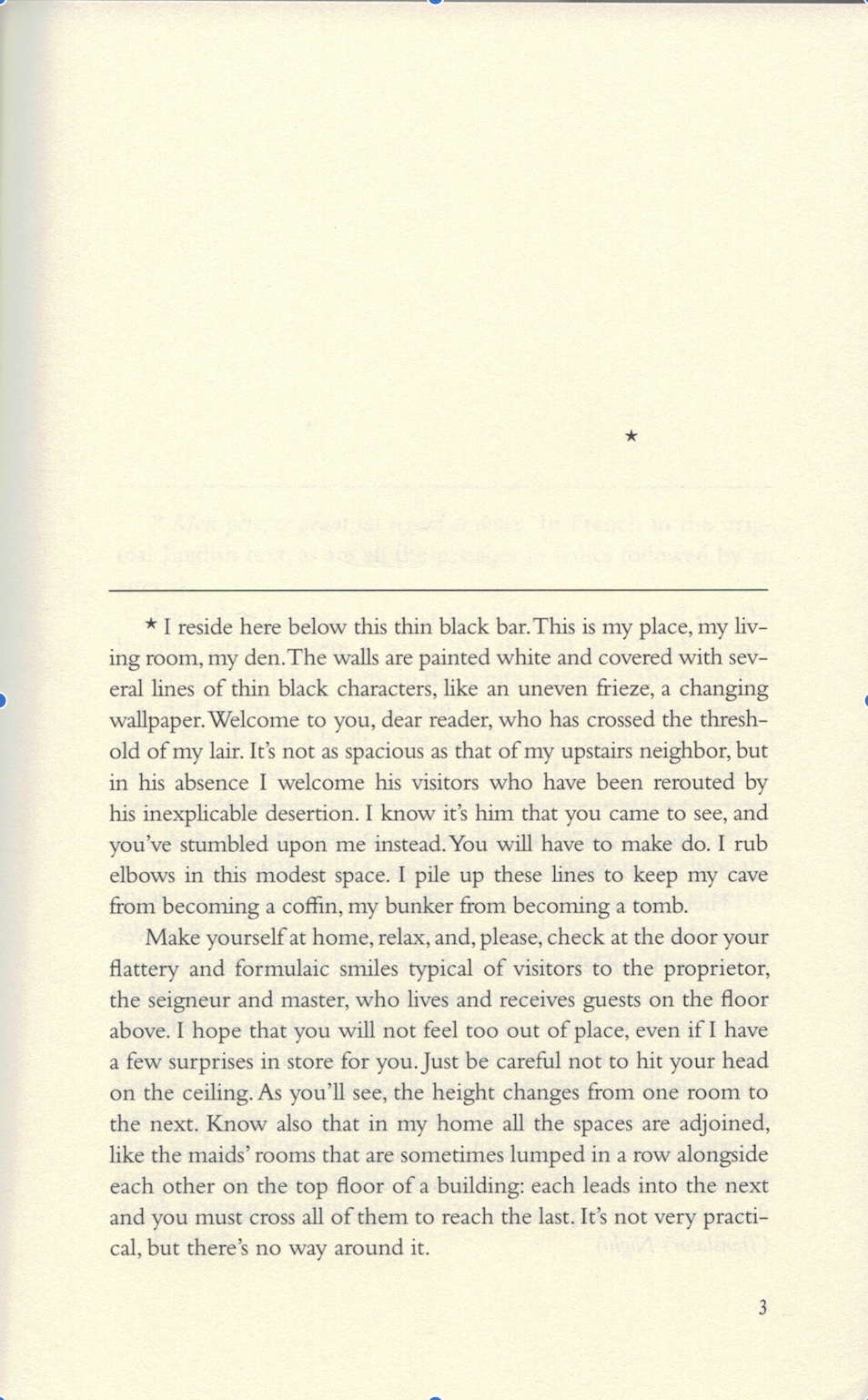
Start with the format. The first 205 pages (of 331) purport to be footnotes addressed by the translator to the reader: “*I reside here below this thin black bar . . . Welcome to you, dear reader, who has crossed the threshold of my lair.” 

The translator, who has a lot to say about literature, translation, the book he’s translating into French (in French it should be Vengeance du Traducteru, but of course the publisher will have to agree) is by one “Abel Prote” and the protagonist of the book is “David Grey, American translator of French novels.” Another key character is “the beautiful Doris,” who may be a character in the book or a lover of the author or neither or both.

Early on, the translator discusses his impatience with the book he’s translating. To improve it, he begins “trimming the fat,” first by eliminating all adjectives. “His prose has become almost good, the bastard. And since he barely speaks French, he won’t suspect as thing.”

That improves the text so much, he cuts all the adverbs. That works so well, he deletes all the tags that follow dialogue, such as: “‘_______!’ hurled Doris in a defiant voice as she walked toward him.” 

Or: “‘_______,’Grey replied coldly.” 

And: “‘_______,’ Grey cut her off, drawing right up close to her beautiful face with its slightly hooked nose.” It was at this point I laughed aloud.

Ten pages later, a chapter begins, “The character of Doris, the ‘servant with a big heart’ and personal secretary to Abel Prote, seems insufficiently developed to me.” First, I thought Abel Prote was the author of the novel, and second, what’s the translator doing “fleshing out” the author’s characters?

The book becomes even more meta. On page 73 we read, “Seized by a sudden idea, Prote envisages writing a novel entirely composed of footnotes. . . He gets up from his bed and sits in front of his computer. . . and he begins: ‘I reside here below this thin black bar. . . .” 

But there’s more: “Then the telephone rings. I pick up. A guy, a French guy, tells me in French that (N.d.T) is actually part of an American novel, called Translator’s Revenge which is in the process of being translated for a Parisian publisher. He adds that I, David Grey, am a character in this novel. Same for Abel, the author of (N.d.T), and for you, Doris. Can you imagine? If we were all characters of a novel being translated into French! He wants to see me . . . .” (p.195).

I cannot imagine the effort to translate and so my enthusiasm is unlimited for Emma Ramadan, a real person, who has translated this farrago from French into English. Revenge of the Translator has some lovely writing, and some interesting thoughts about translation. (What do you do if you hate the original? When, if ever, do you cut? Improve? If, as I’ve read, Martin Heidegger is more accessible in English than in the original German, has the translator done him a service or a misrepresentation?)

I think Brice Matthieusssent wants it both ways; to write a traditional realistic novel and to write something entirely original. He studied engineering and as a graduate student obtained a doctorate in philosophy. He has taught the philosophy of aesthetics and the history of contemporary art in Marseille, as well as translation courses in a Parisian university. He’s written seven novels and translated the fiction of Jim Harrison, Jack Kerouac, Henri Miller, Charles Bukowski, Bret Easton Ellis, Gore Vidal, Larry Kramer, Annie Dillard, Paul Bowles, William Burroughs, and many more into French.

Revenge of the Translator is clever, but I find it empty. That, however, may well be my failure rather than Matthieussent’s or Emma Ramadan’s, his virtuoso translator who turns up on the last page of the book: “Someone’s just rung the doorbell. I have a meeting with my American translator, who’s visiting Paris. A certain Emma Ramadan . . . We’re supposed to work the entire afternoon on the most difficult passages of my novel . . . .”  Clever. 

Thursday, October 28, 2021

A fascinating life of an imaginary Toronto doctor

 Robertson Davies (1913-1995) was a Canadian novelist, playwright, critic, journalist, and professor. According to Wikipedia—and I have no reason to question their article—he was one of Canada's “best known and most popular authors and one of its most distinguished ‘men of letters,’ an unfashionable term Davies gladly accepted for himself.” He published a dozen works of fiction, more than eight plays, and eight books of criticism and essays. The Cunning Man(1994), a novel, was his last book.

It’s an old man’s book narrated by an old man, Dr. Jonathan Hullah, MD, who purports to be writing up confidential Case Notes. The pages incorporate a mystery, a bildungsroman, an autobiography, a romance, and meditations on religion, medicine, art, literature, and much, much more. 

The book is so rich, so packed with incident and characters, so studded with interesting thoughts and observations, I am afraid it is beyond me to summarize the plot. Basically, Jon grows up in a small town in northern Ontario in which his father is the manager of the mine that is the reason for the town’s existence.

The town abuts a native people’s “reserve,” and Jon is healed of scarlet fever by and becomes friends with Mrs. Smoke, a “wise woman” and herbalist. He is shipped to Toronto to a private boys school where he makes lifelong friends with Brochwel Gilmartin, who becomes a professor, and Charlie Iredale, who becomes an Anglican priest at St. Aidan’s, an Episcopal church that is—except for the Pope—is more Catholic than any Catholic church in Toronto with a mixed choir for the hymns, an eight-man men’s choir for plainsong, the best organist in town, incense, vestments, and more.

The mystery running through the book is what actually happened to old Father Hobbes, who drooped dead in front of the High Altar at St. Aidan’s just as he lifted the consecrated host. Jon was in the church at the time and hurried to help although no longer a police surgeon, but Charlie, who was also officiating in the service, waved him away. The curious event of Father Hobbes’s death pulls the reader through the novel. The explanation is unexpected and satisfying.

Along the way to the denouement with plenty of digressions en route, we watch Jon grow up in tiny, remote Sioux Lookout, follow his school days at Colborne and at university where he falls victim of a clever practical joke. In an amateur theatrical group, he meets and falls in love with Nuala Conor. 

Nuala “was the first girl I met with a genuine sense of humour. Of course, I had known many girls who laughed a lot, often when there was nothing to laugh at, and behind their girlish laughter there might always be seen the mirthless faces of their mothers, grim prophecies of what those girls would in time become.” 

They become lovers and remain lovers for fifty years, though Jon never marries and Nuala marries Jon’s friend Gilmartin. Nuala has a son who could possibly be Jon’s child, though in those pre-DNA times, the boy’s paternity remains a question in Jon’s mind.

We live through WWII with Jon as a doctor who is almost killed by an unexploded bomb that explodes as he’s is taking a bath in a London hotel. He recovers and helps badly wounded Canadian soldiers who suffered from “friendly fire.” War is bad enough; how much worse to lose a limb to your own troops?

Back in Toronto, Jon settles into a life as a police surgeon and is a wiz at diagnosis. He builds a career as the MD who will take patients other doctors have found insufferable, those for whom medical science find no proximate cause for their pain but which sends them from one practitioner to another until they wash up in Jon’s surgery.

The Cunning Man is worth studying to understand how it’s constructed: what Davies dramatizes as an important scene/event in the narrator’s life, what he chooses to simply tell as a way to move the story along, how he describes characters (like the snippet about Nuala above), and how he uses a variety of techniques to maintain the reader’s interest over 469 pages in the life of an invented Toronto doctor.

I did not expect to enjoy in the book as much as I did. (What do I care about 20th century Toronto life?) But on reflection, I realize it has more to teach me. I am going to keep it and will read it again.